
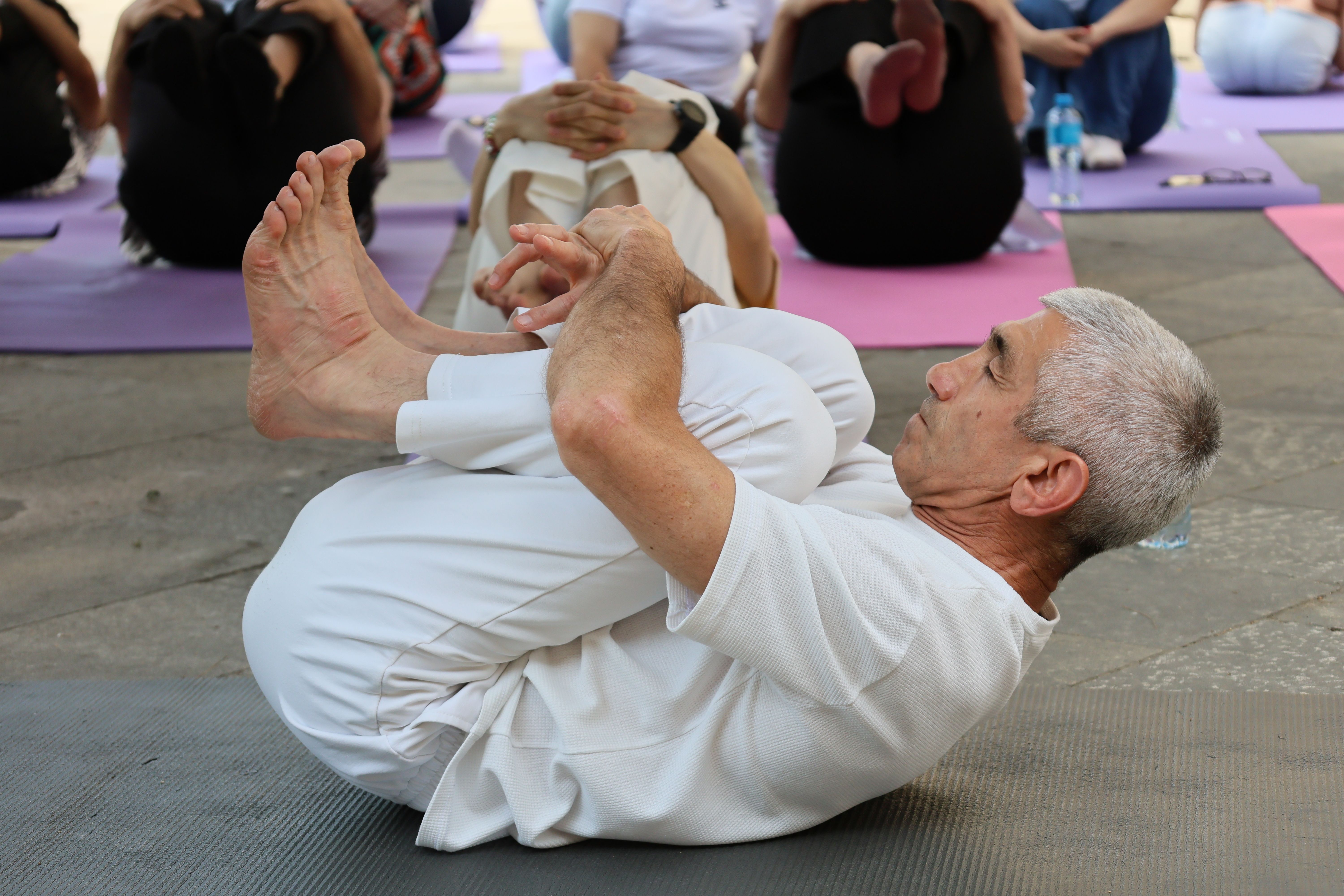
Yoga appears in American school gymnasiums, community centers and corporate wellness programs in a form built by successive adaptations. Tracing that path explains what the American version contains.
The physical emphasis arose before it arrived
Postural practice as the dominant element of yoga developed within a period when physical culture, gymnastics and calisthenics were circulating internationally.
Teachers who systematized sequences of postures were working in that environment, and the resulting form was already exercise-oriented before it reached Western audiences.
What was exported was consequently the postural branch rather than the philosophical and ethical framework in which it had historically sat.
Institutional settings shaped the format further
A class fitting a school period or a gym timetable must have a fixed duration, a defined start and end, and a structure a substitute instructor can follow.
Those constraints favor sequences that can be taught to a group of mixed ability without individual assessment, which is a substantial departure from one-to-one transmission.
Group format also removes the extended relationship between teacher and student through which the non-physical elements were traditionally conveyed.
Public school programs faced a distinct legal question
Because American public schools operate under constitutional constraints on religious establishment, yoga programs have been challenged on the grounds that the practice carries religious content.
Programs have generally responded by removing devotional language, using English rather than Sanskrit posture names, and presenting the activity as physical exercise.
Courts examining such programs have looked at what is actually taught rather than the practice's origins, and the litigation reinforced the trend toward a stripped-down physical form.
Adaptation is contested from several directions
Some practitioners and scholars describe the removal of philosophical content as appropriation, arguing the practice is presented without acknowledgment of its context.
Others regard adaptation as normal transmission, noting that the practice has been repeatedly reshaped throughout its history rather than preserved unchanged.
The disagreement is genuine and unresolved, and both positions rest on the same historical record read with different emphasis.
What the resulting class actually delivers
A postural class functions as mobility and bodyweight strength work with attention to breathing, which is a legitimate form of physical activity described accurately in those terms.
Anyone with a recent injury, joint instability, uncontrolled blood pressure, or pregnancy should have a clinician's input on which movements are appropriate, since a group class cannot make that assessment.